Transition as a Social Technology
After nearly two decades deeply engaged in this field, the organizing model developed by the international Transition Towns Movement is still the most holistic, accessible, and effective social technology I’ve found for cultivating more resilient, equitable, sustainable, and regenerative local communities from the bottom up. Based on the experience of thousands of Transition groups worldwide, it’s an open-source methodology that anyone can pick up, use, and adapt to their community’s needs, interests, opportunities, and culture, regardless of whether or not they consider themselves part of the Transition Movement.
As I’ve come to understand it, there are two primary dimensions of this model. One is the Seven Essential Ingredients of Transition, which point out the most important aspects of changemaking we need to pay attention to at every stage of the process. The other is the Five Stages of Transition, which describe how these Ingredients typically evolve over time.
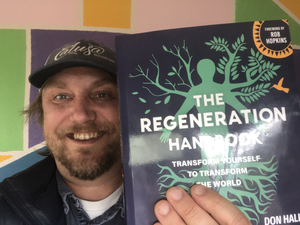
While several different versions of the Essential Ingredients have been proposed over the years, below is the version I used for my book, The Regeneration Handbook: Transform Yourself to Transform the World (2024), as well as the self-directed, online Transition Launch Training I recently produced with a dozen experienced Transition Trainers from around the world:

Context: Understanding the most important challenges we’re currently facing and how they’re all interconnected as part of an unprecedented global environmental, economic, and social polycrisis.
Vision: Imagining a better future beyond the Great Unraveling of the Industrial Growth Society and identifying key strategies that will help us get there.
Inner Transition: Engaging in the inner work we need to do to become the leaders we need to be.
Healthy Groups: Learning valuable practices and processes for effective collaboration and conflict transformation.
Community Engagement: Establishing a base of support and reaching out beyond the choir to build a movement big enough to matter.
Practical Projects: Implementing innovative solutions that produce tangible benefits, generate credible hope, and shift entire systems towards regeneration.
Part of a Movement: Banding together with other local initiatives to affect change at regional, national, and international levels.
The Five Stages were initially articulated by Transition Movement co-founder Rob Hopkins in his 2011 book, The Transition Companion: Making Your Community More Resilient in Uncertain Times. Below are brief summaries of each these stages, based on my Regeneration Handbook:

Starting Out: Forming an “initiating group,” providing education about both challenges and solutions, building a base of support, and exploring what your community’s greatest needs, interests, and opportunities are.
Deepening: Becoming a formal organization and beginning to establish impactful practical projects that deliver tangible benefits and demonstrate that even bigger change is possible.
Connecting: Reaching beyond the early adopters to meaningfully engage local businesses, governments, media outlets, funders, and major cultural institutions, weaving them all together into a larger movement.
Building: Expanding organizational capacity and implementing larger systems-changing strategies.
Daring to Dream: Actually transitioning your community as a whole and working with other communities around the world to bend the long arc of history towards regeneration.
Remarkably, the Five Stages show how a group can start with no prior experience and minimal resources and end up changing the world. By cross-referencing them with the Seven Essential Ingredients, we can create an even more detailed map of Transition-style organizing than either of them offers alone.
Of course, there’s much more to learn about this important social technology, so if you’re interested in diving deeper, I’d suggest checking out our evergreen Transition Launch Training, which you can now take for free at any time in 70 languages. Because it’s an introductory course, Launch mainly focuses on the Starting Out and Deepening stages, but stay tuned for Transition Thrive, which expands beyond them into Connecting and Building.