Nobody Ever Said Changing the World Would Be Easy
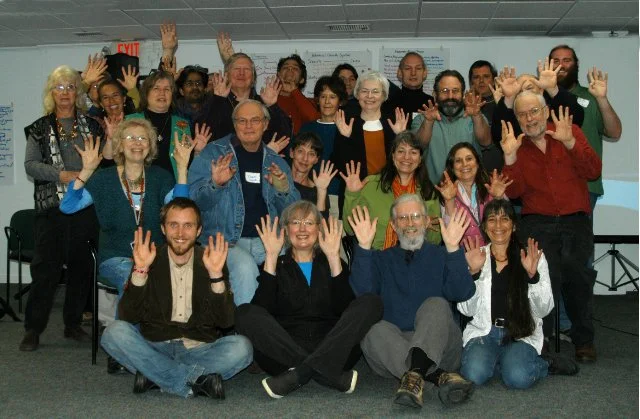
Group photo from the second Training for Transition held in the US, in 2009 in Boulder, Colorado.
In my experience, working to bring about a truly just, sustainable, and regenerative future has been many things: deeply meaningful, endlessly fascinating, hugely transformational, and overwhelmingly rewarding. It can also be transcendently joyful at times. Nevertheless, nobody ever said changing the world would be easy.
While this seems obvious, we could all be forgiven for thinking otherwise. The great Richard Heinberg, in his Foreword to The Transition Handbook, famously remarked that Rob Hopkins had “found a way for people worried about an environmental apocalypse to invest their efforts in ongoing collective action that ends up looking more like a party than a protest march.” Hopkins himself seemed to imply something similar when he suggested “Let it go where it wants to go” as one of his original Twelve Steps of Transition.
These statements powerfully conjure up a spirit of creativity and celebration that continues to be an essential part of the Transition Towns Movement, but they also gave many people the mistaken impression that the Transition Process is meant to unfold intuitively and effortlessly, as if by magic. Although transforming one community is certainty easier than trying to change the whole world, running a local Transition group remains undeniably challenging. Consider, for example, just a few of the many hats Transition leaders need to wear and the many tasks we need to become good at:
Understanding the interconnected environmental, economic, social, and political trends that are currently shaping our planet and the places we live.
Developing a holistic vision for the future that’s both realistic and hopeful enough to be compelling.
Collaborating with people from diverse backgrounds with diverse preferences and opinions, weaving them together into a unified movement.
Designing and facilitating successful meetings, events, programs, and campaigns that build momentum and prove a better world is still possible.
Measuring the impact of our work and telling irresistible stories about it.
Reaching beyond the choir to engage more and more people and partners over time.
Managing and scaling up a complex organization, including raising the funds necessary to support it.
Working with our own personal shadows and uncovering our hidden potential to become the trustworthy, compassionate leaders our communities need us to be.
Avoiding burnout and maintaining balance to persist and thrive over the long run.
Of course, we don’t have to master all these skills ourselves, especially not right from the start. However, we do need to learn many of them eventually, particularly in groups where resources are limited and we can’t afford to outsource everything to experts.
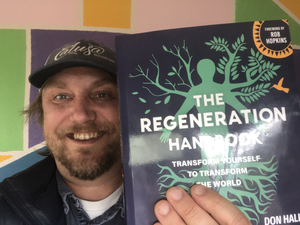
That’s one big reason why Transition is an international learning network. Drawing on the experience and insights of more than 1,000 groups worldwide who have been doing this work for almost two decades now, we’ve compiled stories of replicable models, convened communities of practice, produced how-to guides and webinars, and developed trainings that can save us from having to reinvent the wheel and help speed us on our way. Most immediately, I’ll be offering a free online discussion course based on The Regeneration Handbook: Transform Yourself to Transform the World, starting July 19th.
And beyond Transition Network International and its 18 regional and national Transition Hubs, there are many other amazing organizations we can learn from that are part of a much larger movement of movements. A few of my favorites include Post Carbon Institute, Shareable, Gaia Education, the Permaculture Institute of North America, the Work That Reconnects Network, Sociocracy for All, Evolving Organisation, and the Foundation for Intentional Community.
Nobody ever said changing the world would be easy, but by engaging in a process of lifelong learning and continual evolution, we can make this work much easier on ourselves, sense and steer it where it “wants to go,” and create plenty of opportunities to celebrate along the way.